
Why We're Building Muza

Why We're Building Muza
For most of the history of photography, taking a picture and deciding what to do with it were two separate acts. You took the photo. Later – sometimes much later – you decided whether it was worth keeping, printing, showing to anyone.
Social media collapsed that gap into nothing. Now the photo, the decision, and the audience arrive in the same instant. A phone comes out, a photo is taken, and within seconds a person is expected to also be an editor, a strategist, a copywriter, and a publisher – all before the moment they were trying to capture has passed.
We started building Muza because we don't think one person should have to be all of those things at once, every single day, indefinitely.
The Job Nobody Signed Up For
Almost nobody who starts posting on Instagram or TikTok sets out to become a part-time marketing department. They start because they have something to show – a business, a face, a life, a skill. Somewhere along the way, showing up regularly stops being optional. The account needs a consistent look. The captions need a hook. The grid needs a rhythm. The numbers need to be checked, interpreted, and acted on.
None of this is what people signed up for. It's what the format demands of them if they want to be seen at all.
Most tools built for this moment focus on one slice of the job. A filter app makes one photo look better. A scheduling tool moves a draft from a device to a feed at the right time. A caption generator writes a sentence. Each of these is useful in isolation, and none of them address the actual shape of the problem, which is that the work is not one task – it's a chain of very different tasks, done by very different kinds of thinking, one after another, week after week.
The Cost of Doing It Alone
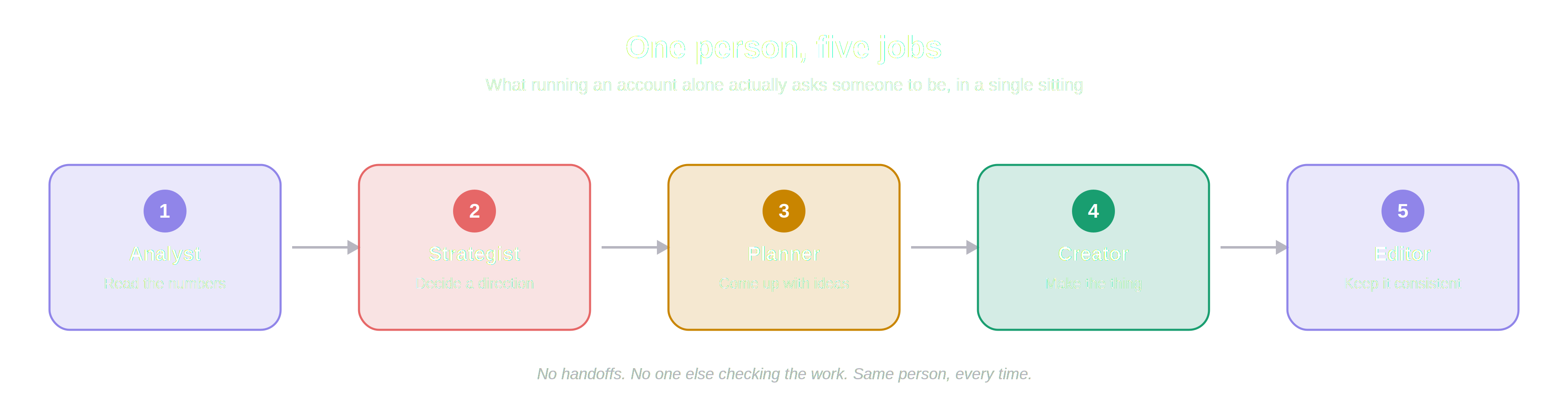
It's worth being specific about what "doing it alone" actually costs, because it's easy to underestimate when the tasks are broken into small pieces. Looking at a profile's numbers and figuring out what they mean is analytical work – it asks for a kind of detached, pattern-spotting attention. Deciding what a page should focus on next is strategic work – it asks for judgment about tradeoffs and priorities. Coming up with a specific idea for Tuesday is creative work under a constraint. Turning that idea into a finished script or photo concept is craft. Making sure it all still sounds like the same person, month after month, is editorial consistency.
Show Image
A single person doing all five of these, back to back, in the same sitting, is doing the cognitive equivalent of five different jobs without ever clocking out of one before starting the next. It's not that any individual piece is especially hard. It's that switching between fundamentally different modes of thinking, over and over, with no handoff and no one else checking the work, is exhausting in a way that's easy to misattribute to "I'm just not good at social media" rather than to the actual structure of the task.
We didn't want to build another tool that makes one of those five jobs slightly faster. We wanted to build something that takes the other four off a person's plate entirely, so that the one job most people actually enjoy – making the thing – has room to be the only job left.
From Editing Tool to Creative Partner
Editing a photo well requires an eye for light, skin, proportion, and mood. Deciding what a page needs this month requires something closer to strategy – reading what's working, what isn't, and why. Turning that strategy into an actual topic for Tuesday's post requires creativity under a constraint. Turning that topic into a finished script or visual requires craft. And making sure all of it still sounds like the same person requires a kind of editorial judgment that has nothing to do with any single photo.
These are not variations on the same skill. They're different skills entirely, and asking one person – or one generic AI tool that does "a bit of everything" – to hold all of them at once is part of why so many accounts feel effortful to run and impossible to keep up with.
Muza's editing tools exist for the same reason any good editor exists: to make a photo or a clip look like the best version of itself, quickly, without needing a studio. Retouching, body correction, one-tap makeup, color grading, filters built with an eye for what actually flatters real photos rather than flattening them – that half of Muza is not new in spirit. People have always wanted their photos to look considered.
What's different is what sits behind the editor.
What a Team Around One Person Looks Like
Inside Muza there isn't a single assistant trying to do everything. There's a small team, each member responsible for one part of the chain: one that looks honestly at what a profile's numbers are actually saying, one that turns that reading into a direction worth pursuing, one that fills that direction with concrete topics and ideas, one that turns those ideas into finished posts, and one that keeps the whole thing coherent and on schedule.
We built it this way on purpose. A single AI trying to diagnose a profile, invent a strategy, generate content, and quality-check itself tends to blur all four into a kind of average – plausible-sounding, but not particularly sharp at any one of them. Splitting the work the way a small, well-run team would split it produces sharper thinking at every stage, because each part is only being asked to do one job well, and to hand off cleanly to the next.
This is closer to how any serious content operation has always worked, just compressed into something one person can carry around in their pocket, without hiring anyone.

What We Learned From Watching People Try to Do This Manually
Before any of this became a product decision, it was an observation. Talk to enough people who run an active social account – a small business owner, a photographer building a personal brand, a creator trying to turn a hobby into something sustainable – and a pattern shows up quickly. Almost no one fails at this because they can't take a good photo or write a decent caption. They fail, or burn out, or quietly go inactive, because the planning part never gets a fixed home in their week. It gets squeezed into whatever fifteen minutes are left at the end of a day, which is exactly the fifteen minutes when a person has the least capacity left to think clearly about strategy.
That observation is what convinced us that the editing tools, however good, were never going to be the part that determined whether someone kept showing up consistently. The planning and decision-making layer was the actual bottleneck, and it was the layer that every existing tool we looked at treated as an afterthought – a scheduling calendar bolted onto an editor, or a caption generator bolted onto a scheduler, with no real thread connecting a profile's actual situation to what gets made next.
Editing Alone Was Never the Hard Part
If you asked most people what the hardest part of running a social account is, they rarely say "I don't know how to use editing tools." They say some version of: I don't know what to post. I don't know if what I'm doing is working. I run out of ideas by Wednesday. I don't have time to figure out a plan and also make the thing.
That's the part we set out to build for – not instead of a good editor, but around one. A tool that only makes photos prettier still leaves someone standing in front of a blank feed, wondering what to shoot next. A team that helps answer that question, and then helps make the answer real, changes what the whole experience of maintaining a presence online actually feels like.

A Different Kind of Assistant
We don't think the answer to content fatigue is more content, faster. We think it's fewer decisions made alone, at the end of an already long day, with no real sense of whether any of it is working.
Muza exists to take on the parts of the job that were never really about creativity in the first place – the diagnosis, the planning, the coordination – so that the part that is about creativity has more room to actually happen. Not a filter. Not a shortcut. A team, built to fit inside one app, working quietly in the background so that showing up online can go back to being about the thing someone actually wanted to share, not everything they had to become in order to share it.