
Why We Don't Chase Every Trend

Why We Don't Chase Every Trend
A new editing trend shows up on social platforms roughly every few weeks: a color grade everyone suddenly wants, a face-shape effect that spikes for a month and vanishes, a specific aesthetic that a handful of viral posts turns into a temporary must-have feature. Every one of these moments comes with real, measurable demand, and every one of them puts the same question in front of us: do we build this, right now, while it's hot?
Most of the time, the answer is no. Not because the trend isn't real, and not because we think the people asking for it are wrong to want it – but because a feature built to catch a two-week spike and a feature built to hold up a year from now are different engineering problems, and we've learned the hard way that they don't come from the same process.
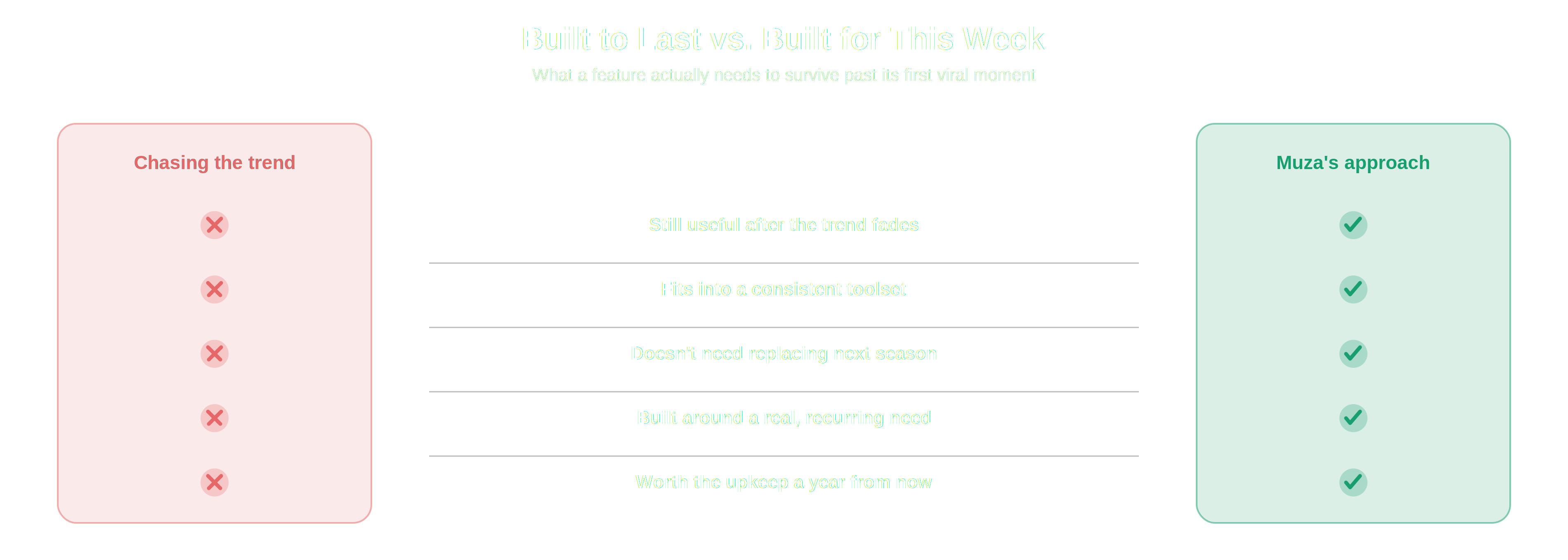
What Chasing a Trend Actually Costs
The obvious cost of building for a trend is timing – by the time a feature ships, the trend that inspired it may already be fading, and the team has spent real effort on something with a shrinking audience. That cost is real, but it's not the one that worries us most.
The less obvious cost shows up after the trend is gone and the feature is still sitting in the app, half-used, quietly adding to the surface area of things that need to be maintained, tested, and explained to new users – without adding much value to justify the upkeep. Every feature in an app carries a permanent cost: it needs to keep working across new devices and new OS versions, it needs a place in the interface that isn't given to something else, and it needs to make sense to someone opening the app for the first time long after whatever inspired it has stopped being culturally relevant. A trend-driven feature rarely earns that ongoing cost back, because it was never built around a need that outlasts the trend in the first place.

The Test We Actually Use
Instead of asking "is this popular right now," the question we ask before committing real engineering time to a new capability is closer to: will someone still want this, and still use it the same way, a year after the trend that inspired it has been forgotten? This sounds like a simple filter, but it changes which requests get prioritized in a way that isn't always obvious from the outside.
A request for "the effect from that one viral video" usually fails this test, not because the underlying visual idea is bad, but because it's tied to a specific cultural moment rather than a durable need. A request that sounds less exciting on paper – better handling of low-light photos, more consistent skin tone matching across a range of complexions, faster processing on older devices – usually passes it easily, because the need behind it doesn't go away when the algorithm moves on to the next thing. We'd rather spend a sprint on the second kind of request, even though it will never trend on its own, because it's still paying off long after the first kind would have been quietly retired.
When a Trend Is Actually a Signal
None of this means every trend gets ignored, and treating trends as inherently unworthy of attention would be its own mistake. Sometimes a trend is really a visible symptom of a need that was already there, and the viral moment just gave it a name and an audience. When a specific look becomes popular for reasons that have nothing to do with the trend cycle itself – because it solves a real, recurring problem people have been quietly working around for a while – that's worth building, and building well, not as a copy of whatever sparked the moment, but as a durable version of the actual underlying capability.
The distinguishing question isn't whether something is currently popular. It's whether the popularity is revealing a real, ongoing need or just riding a specific piece of content that happened to go viral. A trend that's really about "people want more control over how warm their skin tone looks in different lighting" deserves a real, general feature. A trend that's really about "this one specific filter from this one specific video is fun right now" usually doesn't, however much short-term attention it could generate.

Saying No Slower, Not Faster
It would be easy to describe this philosophy as simply saying no to trends, but that's not quite accurate, and it undersells the actual discipline involved. We don't reject trend requests quickly – we sit with them longer than feels comfortable given how fast the underlying trend is moving, specifically to separate the part that's genuinely durable from the part that's just riding a moment. That's slower than either building everything that trends or dismissing everything that trends, and it means we sometimes miss a window where a feature would have looked impressively responsive if it had shipped in the first two weeks of a trend's life.
We've made peace with that tradeoff. A feature that ships fast and gets retired quietly six months later doesn't actually serve the people who asked for it – it serves the appearance of responsiveness, at the cost of a product that slowly accumulates half-used, orphaned capabilities nobody wants to be responsible for maintaining. A feature that takes longer because it was built around the durable need underneath a trend, rather than the trend's specific surface appearance, is the one that's still worth having when nobody remembers what started the conversation.
A Real Example of Getting This Wrong
We haven't always gotten this balance right, and it's worth naming a case where we didn't, because the mistake is more instructive than the successes. Early in Muza's development, a specific color-grading look tied to a single viral trend generated enough requests that we built a dedicated one-tap preset for it within a couple of weeks – faster than our usual process, specifically because the demand felt urgent. The preset shipped, got used heavily for about a month, and then usage dropped off a cliff as the trend that inspired it faded from feeds entirely. Six months later, it was one of the least-used presets in the entire library, sitting in the interface, still needing to be tested against new OS updates, still showing up in support questions from people who didn't understand what it was for.
That preset taught us something the abstract version of this philosophy hadn't fully landed until we lived through it: the cost of a trend-chasing feature doesn't show up at launch, when everything looks like a success. It shows up quietly, months later, as one more thing the team has to maintain, explain, and eventually decide whether to remove – a decision that's always more awkward than not building it in the first place, because removing a feature someone might still occasionally open feels riskier than it actually is. We kept a version of that preset's underlying color logic, folded into a more general grading tool, and retired the trend-specific framing entirely. The lesson generalized well beyond one preset: when a fast-moving request does turn out to be worth building, the durable version of it is almost never the literal thing that was asked for in the moment.

What This Looks Like From the Outside
The honest tradeoff of this approach is that Muza will sometimes look, from the outside, like it's slower to react than an app built purely to chase engagement spikes. We're aware of that perception cost, and we've decided it's worth accepting in exchange for a product that doesn't quietly fill up with features nobody's used in six months. A tool people keep coming back to for years is built differently than a tool designed to look current for the length of a single trend cycle, and those two goals pull hard enough in opposite directions that a team has to actually choose one.
We've chosen durability, even when it costs us a viral moment now and then. Not because trends aren't real or interesting, but because the actual measure of whether a feature was worth building isn't how many people wanted it during its first two weeks – it's whether it's still doing something useful long after the moment that inspired it has been forgotten by everyone except the team that had to maintain it.