
Why Natural Beats Perfect

Why Natural Beats Perfect
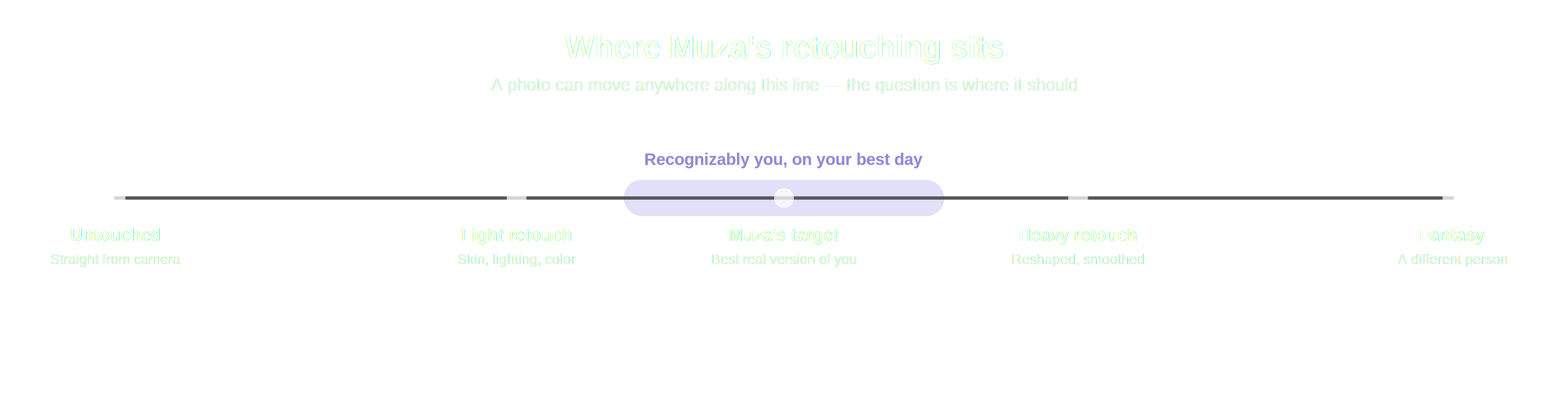
Every retouching tool eventually has to answer a question it usually avoids stating out loud: how far is too far? Smoothing skin is retouching. Reshaping a jawline is retouching. Replacing a face with a generated one that resembles the original person only loosely is, technically, still retouching, if you stretch the word far enough. Somewhere between those three things is a line, and most tools don't draw it on purpose – they draw it by accident, wherever their sliders happen to stop working well.
We spent a long time on this question before writing a single line of Muza's retouching code, because the answer determines almost everything downstream: what the sliders max out at, what the one-tap presets actually do, what a "good" result looks like when a designer is judging whether a feature shipped correctly. Get this wrong and you end up with a tool that either does too little to feel worth using, or does so much that the person in the photo starts to look like someone else.
The Two Failure Modes
It helps to name both failure modes plainly, because they pull in opposite directions and a tool can only fail toward one at a time.
The first failure mode is a tool that's too timid. It smooths a blemish, evens out lighting, and stops – technically an edit, but not one that changes how a photo feels to look at. People using tools like this often end up stacking three or four apps to get a result that one confident tool should have handled, or they give up and post the unedited version, which defeats the purpose of offering editing tools at all.
The second failure mode is a tool that's too aggressive by default, where the fastest path to a "good" result is also the path that makes someone look like a slightly different, suspiciously smooth person. This failure mode is more dangerous precisely because it doesn't feel like a failure in the moment. The photo looks polished. It's only later, held up next to other photos of the same person, or next to a mirror, that the gap becomes visible – and by then the tool has already done its job of making the exaggerated version feel normal.

Picking a Target on the Spectrum
Once you draw the spectrum out, the interesting design decision isn't at either end – nobody is trying to build a tool that does nothing, and we were never trying to build a face-swap generator. The interesting decision is exactly where in the middle to aim the defaults, because defaults are what most people actually use. Sliders can technically reach further in both directions, but a tool is defined by where it points a first-time user, not by what's theoretically possible if someone pushes every setting to its extreme.
We settled on a target we describe internally as "recognizably you, on your best day" – not the photo from a slow morning with bad light and no sleep, and not a photo of a person who looks like you but isn't quite you. The test we kept coming back to during development was simple to state and surprisingly hard to satisfy: if you showed the edited photo to someone who knows this person well, would they say "wow, great photo" or would they say "who is that?" Only the first answer counts as success.
This sounds like an obvious bar to clear until you actually try building against it. Skin smoothing that removes texture without a limit doesn't just remove blemishes – past a certain point it removes the pores, fine lines, and subtle asymmetries that make a face read as a specific person's face rather than a generic one. Body correction that isn't capped can subtly change proportions in ways that are individually invisible but additive: a slightly narrower waist here, slightly longer legs there, each adjustment defensible in isolation and collectively enough to produce a body shape the person doesn't actually have.

Why the Defaults Do More Work Than the Sliders
Most retouching tools put the responsibility for staying within a reasonable range entirely on the user, via sliders that go from zero to some arbitrary maximum with no signal about where "arbitrary maximum" starts to look strange. We think that's backwards. A slider that technically supports restraint but defaults to something extreme isn't neutral – it's nudging people toward the failure mode that's harder to notice in the moment and more likely to cause regret later.
So the actual design work in Muza's retouching isn't really about the sliders at all – it's about where the one-tap presets land, because that's what the majority of people actually use. A one-tap preset that produces a subtle, well-judged version of "your best day" does more to keep a whole userbase inside a healthy range than any amount of fine-print advice about using sliders responsibly. If the default is right, most people never need to think about the line at all. If the default is wrong, no amount of optional restraint further down the interface fixes it, because most people never scroll that far.
This is also why body correction in Muza is capped rather than open-ended, even though an uncapped version would technically be possible and might even test well in a short demo. A cap that stops a proportion adjustment before it crosses into "different body" isn't a limitation we apologize for – it's the actual point of the feature. The goal was never maximum reshaping capability. It was a tool that makes people look like themselves, at their best, without quietly asking them to accept a slightly different self as the price of a good photo.

What Users Actually Ask For
It would be convenient if this design philosophy were purely a matter of principle, decided in a vacuum and imposed on users who might have preferred something more extreme. In practice, it tracks closely with what people actually say when you ask them what they want from an edited photo. Almost nobody, when asked directly, says they want to look like a different person. What they say, in various phrasings, is that they want to look "like themselves, but on a good day" – rested, well-lit, a little more polished than a candid shot usually manages, but still unmistakably them.
The confusion happens not because people secretly want extreme results, but because it's genuinely hard to tell, slider by slider, exactly where "polished" quietly becomes "different." Nobody sets out to cross that line. It happens one small, individually reasonable adjustment at a time, which is exactly why we think the responsibility for staying on the right side of it belongs more with the tool's defaults than with an individual user's judgment in the moment, mid-edit, trying to decide if one more notch of smoothing is still fine.
Building Restraint Into the Product, Not Just the Marketing
It's easy for any company to say, in a mission statement, that it values natural-looking results over extreme ones. It's a different thing to build that value into the actual mechanics of a product, in ways that show up in engineering decisions rather than just in copywriting. For Muza, that meant a few concrete choices: caps on how far body correction sliders can travel, presets tuned toward subtlety rather than maximum effect, and an internal review process where a retouching preset that makes a test photo look noticeably like a different person gets sent back, the same way a bug would.
It also meant accepting a tradeoff that's uncomfortable from a pure growth perspective: a tool with a visibly dramatic "wow" effect is often easier to market than one whose best results are quiet enough that people mostly just look like a better version of themselves. We think that tradeoff is worth making anyway, because the alternative – optimizing for the most dramatic possible before-and-after – trains everyone who uses the tool, over time, to treat the exaggerated version as the new normal, which is exactly the dynamic that makes people feel worse about how they look the rest of the time, unedited.
The Long Game
A retouching tool that people trust with their actual, everyday photos – not just the occasional glamour shot – has to be one that doesn't ask them to accept a quietly different version of themselves as a condition of looking good. That's a harder target to hit than "more dramatic," and it's much harder to demo in thirty seconds, because the whole point is that a great result from Muza should look like a great photo, not like a great edit.
We'd rather build toward that harder, quieter target than the easier, louder one. Perfect, in the sense of flawless and reshaped and smoothed past recognition, was never actually the goal. Natural, in the sense of unmistakably you, at your best, was.