
The Paralysis Before Posting

The Paralysis Before Posting
The photo that finally goes up is rarely the first one taken. It's usually somewhere in the middle of a small pile of near-identical attempts, most of which will never be seen by anyone, taken and discarded in the minutes before a single one gets deemed good enough. That process – the retaking, the comparing, the second-guessing – happens almost entirely offstage. What other people see is the finished post. What the person posting experienced, just before it, is a compressed, private negotiation between how they actually look and how they're willing to be seen.
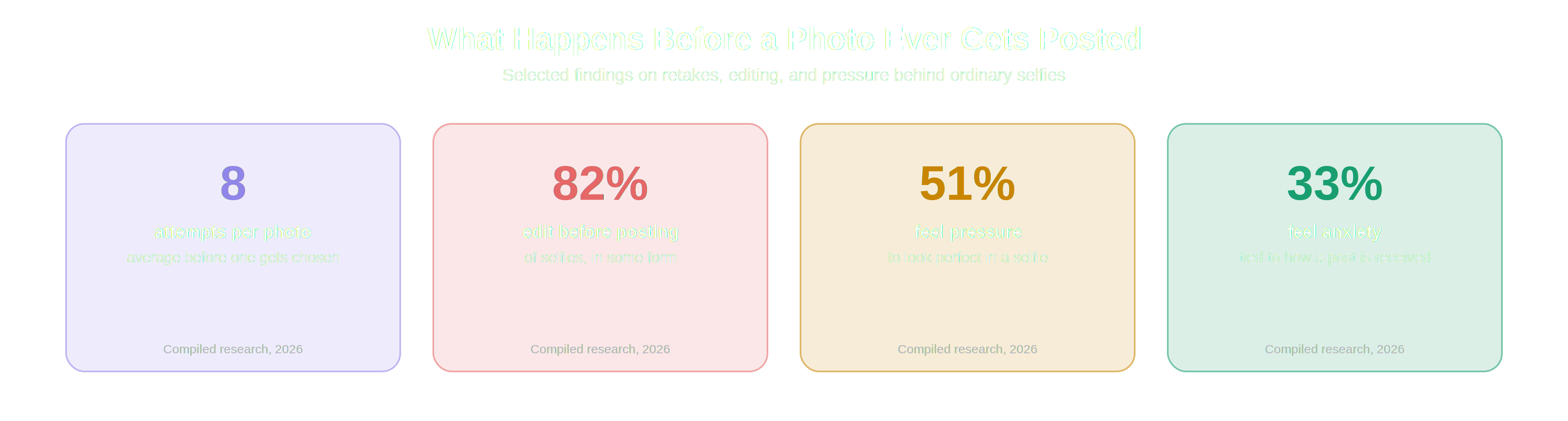
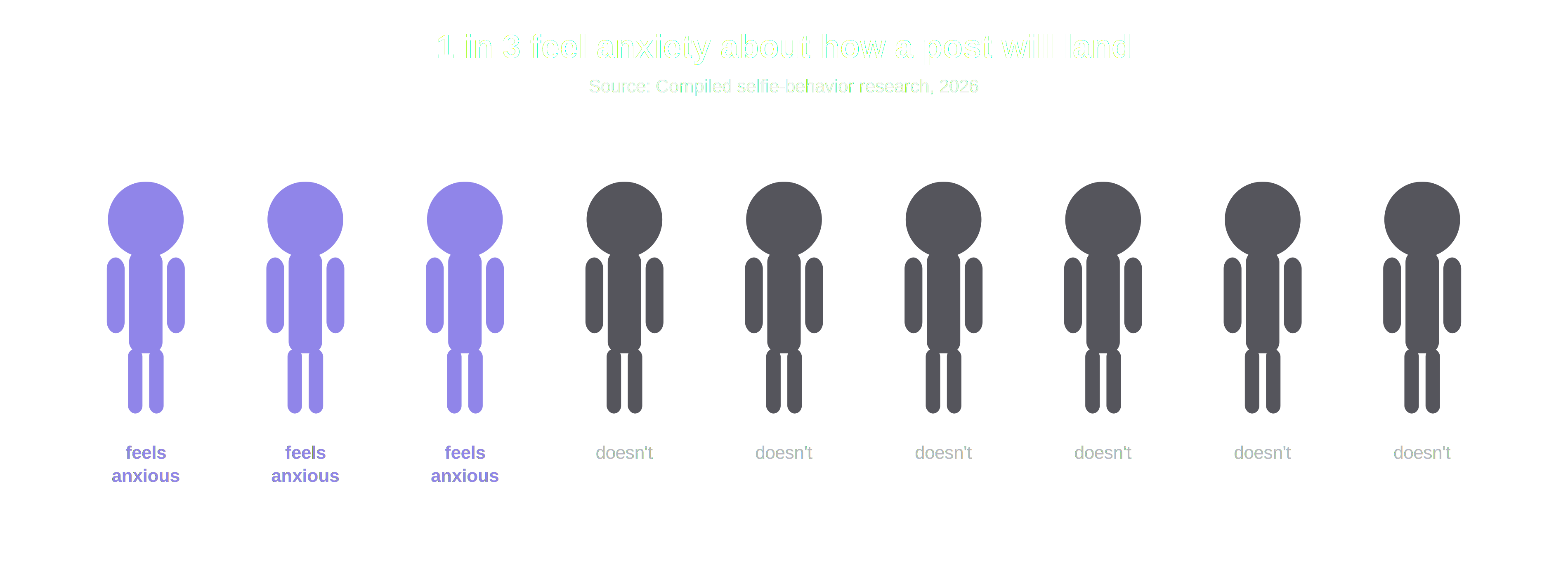
Compiled research on selfie-taking behavior puts a number on that private negotiation that's worth sitting with: people take an average of eight attempts before settling on one final photo. Eighty-two percent edit the photo further after that, in some form, before it's actually posted. Fifty-one percent report feeling real pressure to look perfect specifically in a selfie, as distinct from how they feel about their appearance generally. And a third report genuine anxiety tied to how a post is received once it's out there – not a passing thought, but something closer to a low-grade dread that persists after the post goes live.
Eight Attempts Is Not a Neutral Number
It's tempting to read "eight attempts" as a mildly amusing, relatable fact – of course people take a few extra photos, everyone's done that. But eight is a specific number, not a vague "a few," and it implies something more demanding than casually snapping a couple of backups. Eight attempts means eight small moments of self-assessment in a row: is this the right angle, is the lighting doing something unflattering, does this expression look natural or forced, is this the version I'm willing to have exist. Each of those questions gets asked and answered, silently, in the seconds between one shutter press and the next.
That's a meaningfully different activity than taking a photo. It's closer to a compressed editing session that happens before any actual editing tool gets opened – a process of production and rejection, repeated until something clears an internal bar that, for half of people surveyed, is explicitly described as needing to look "perfect."
The Gap Between Taking a Photo and Deciding to Share It
This is where a useful distinction gets lost in most conversations about photo editing and self-image: taking a photo and deciding to share it are not the same decision, and the anxiety documented in this data mostly lives in the second one, not the first. A person can take a photo they're perfectly comfortable with privately and still spend real time deciding whether it's shareable – a question that pulls in an entirely different set of considerations: how it compares to what they usually post, how they think it will be read by whoever sees it, whether it undersells or oversells how they actually looked in that moment.
The 33% who report anxiety tied to how a post is received are describing something that happens after that decision is made, once the photo is out of their hands and into a feed where its reception is no longer something they control. But the pressure captured in the 51% figure happens earlier, in the choosing – and that earlier moment is the one that repeats eight times, silently, before anyone else ever sees the result.
Why "Just Post the First One" Isn't Realistic Advice
A common, well-meaning response to this data is to suggest people simply lower the bar – post the first decent photo, skip the retakes, stop treating a casual post like it needs to clear some invisible perfection threshold. This advice isn't wrong, exactly, but it underestimates what's actually driving the behavior. The retaking isn't primarily about vanity or an isolated obsession with a single photo. It's a reasonable response to a real, if largely invisible, audience: whatever gets posted will be seen, compared, and silently judged against everything else in a feed built almost entirely out of other people's already-selected best attempts.
Telling someone to stop retaking photos, without changing anything about that surrounding environment, is a bit like telling someone to stop checking twice before crossing a busy street – technically simpler, and ignoring the actual reason the caution exists in the first place. The eight attempts aren't an isolated quirk. They're a rational response to a comparison environment that has, collectively, raised the bar for what counts as postable.

What the Anxiety Is Actually Protecting Against
It's worth taking the 33% figure seriously as information rather than dismissing it as ordinary social nervousness. Anxiety tied to how a post is received is, at its core, anxiety about a specific and fairly high-stakes kind of exposure: putting a version of your appearance into a space where it will be seen by people you can't watch react in real time, compared against a feed of already-curated images, with no ability to take it back once the reaction has started forming. That's a genuinely higher-stakes situation than showing a photo to one friend in person, where a reaction is immediate, contained, and usually kind.
Framed this way, the anxiety isn't an overreaction to a low-stakes activity. It's a proportionate response to an activity that actually does carry some real social risk, repeated dozens or hundreds of times over a person's life on these platforms. The exhausting part isn't any single instance of it. It's that the same small, real risk gets re-assessed from scratch every single time someone considers posting anything.
Where Editing Tools Help, and Where They Don't
A faster, better editing tool can meaningfully shorten one part of this process – the gap between "this photo is close" and "this photo is postable" – by handling adjustments that would otherwise take real manual effort: lighting, small blemishes, the kind of routine correction that used to require retaking the photo entirely to fix. That's a genuine reduction in friction, and it's not nothing.
What a faster editing tool doesn't touch is the eight attempts that happen before editing even starts, because those attempts aren't really about fixing flaws in a specific shot. They're about finding a version of a moment that already feels acceptable enough to build on – and no amount of downstream editing speed changes how many times someone feels they need to press the shutter before they get there. Treating editing speed as the whole solution mistakes the part of the process that's visible and mechanical for the part that's actually driving the behavior.

A Different Kind of Help
This is closer to why we think the more useful intervention isn't a faster edit, but a retouching approach that narrows the gap between an ordinary attempt and an acceptable one – so that fewer of the eight attempts are needed in the first place, not because the editing happens faster, but because attempt three or four already looks like a fair, flattering representation instead of requiring attempt eight to get there. A tool that reliably makes a normal, average photo look like a good one changes the actual arithmetic of the retaking cycle, rather than just speeding up what happens once it's already over.
None of this makes the underlying pressure disappear, and no editing tool should claim to fix a dynamic that's ultimately about a whole shared visual culture, not about any one person's camera roll. But narrowing the gap between "a real photo" and "a postable one" is a concrete, achievable thing a tool can actually do – and it's a more honest target than pretending speed alone was ever the problem.
What the Eight Attempts Are Really Telling Us
The number worth remembering from this data isn't the anxiety percentage or the editing rate on its own – it's that an average of eight attempts happens quietly, before a single photo most people will ever see. That's eight small, private moments of self-assessment behind every post that looks effortless from the outside, and it's a reminder that what a feed shows is never the process, only the outcome the process eventually cleared.
Understanding that gap doesn't require anyone to stop caring how they look in photos they share. It just means being honest about what "just post something" actually asks of people, and building tools that shrink the real distance between an ordinary photo and a shareable one, rather than tools that only make the very last step faster.