
The Mirror That Lies
The Mirror That Lies: What Filtered Feeds Actually Do to Self-Image
Almost everyone editing a photo before posting it has had the same private thought at some point: this is just what everyone does, so it doesn't really change anything. That belief is understandable, and it's also worth examining, because the honest answer is that it changes quite a lot – not necessarily for the person doing the editing in any single instance, but for the shared visual environment everyone, including that same person, has to look at afterward.
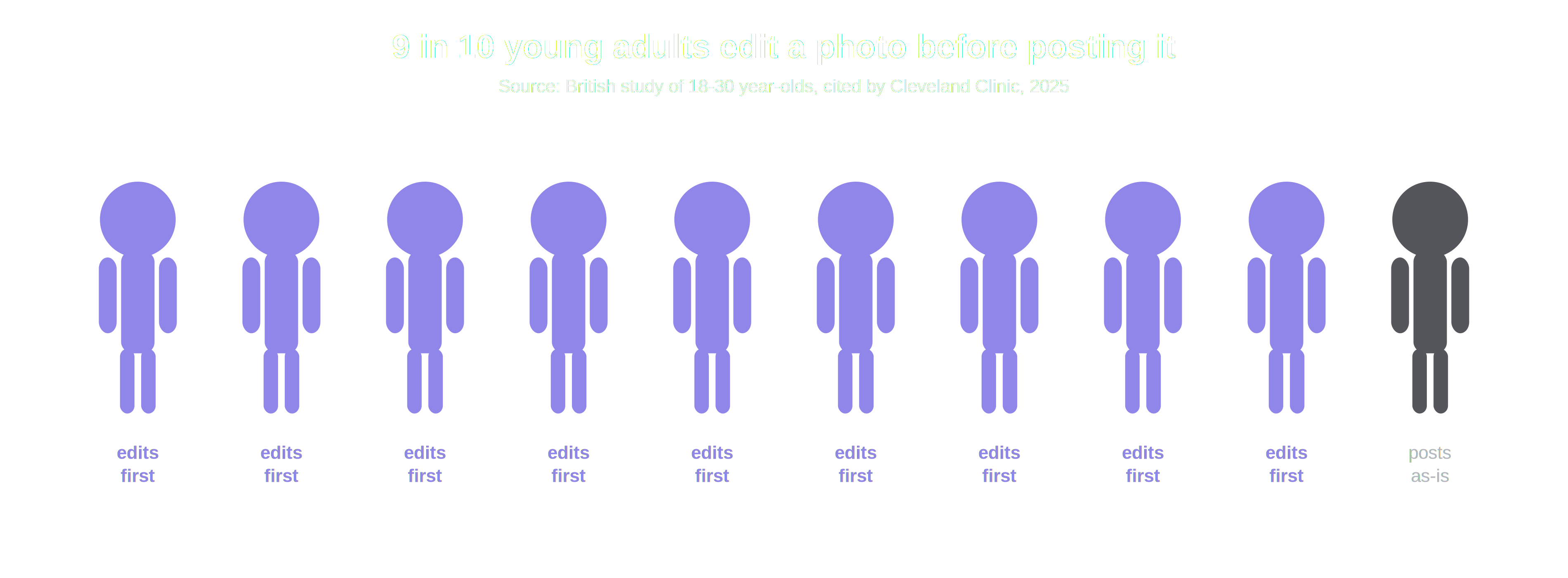
A widely cited British study of 18-to-30-year-olds found that roughly nine in ten edit a photo before posting it – smoothing skin, adjusting lighting, sometimes reshaping a feature, sometimes just brightening a photo taken in bad light. On its own, that statistic barely sounds alarming. Adjusting a photo's lighting is not a new phenomenon; people have retouched portraits since the earliest days of photography. What's different now is scale and mutual invisibility: nearly everyone is doing some version of this, almost nobody is disclosing it, and the result is a feed where the implicit baseline – what a normal, undoctored photo of a person actually looks like – has quietly drifted away from what any of us actually look like on an ordinary day.
The Comparison Nobody Signs Up For
Social comparison is not a new psychological phenomenon introduced by social media – humans have always measured themselves against the people around them. What's changed is the reference group and its editing rate. A person's comparison set used to be mostly people they actually knew, seen in mostly unedited, real-world conditions. Now it includes a scrolling, effectively infinite feed of people they've never met, presented almost exclusively in their best, most edited five seconds, curated and re-shot until one frame looked right.
That shift matters because the comparison itself isn't the problem researchers are flagging – it's that one side of the comparison is real (the person looking at their own reflection or an unedited photo) and the other side is systematically not (a feed of images that have already been filtered toward an unrealistic baseline before anyone sees them). Comparing yourself to a curated best-five-percent of someone else's photos, without knowing that's what you're looking at, isn't a fair comparison. It just doesn't feel unfair from the inside, because the editing is invisible by design.
What the Comparison Actually Costs
The costs of this dynamic show up across multiple independent lines of research, not just one alarming headline number. Compiled research on the topic finds that 46% of young women aged 18 to 24 report worse body image tied to their social media use, and separate figures put the share of teen girls who say filters specifically worsened how they see themselves at around 31%. Other research has tracked a roughly 24% spike in dissatisfaction with one's own appearance linked specifically to the use of face-altering lenses and filters, distinct from social media use in general.
These numbers cluster in a consistent range rather than spiking wildly from one source to the next, which is itself informative – it suggests a real, measurable effect rather than a single overstated study getting repeated uncritically. None of these figures say that social media causes body image struggles in every user, and none of them should be read as a clean, deterministic cause-and-effect chain. What they consistently show is a correlation strong and repeated enough, across different survey populations and different research groups, that it's no longer reasonable to treat filtered feeds as a neutral backdrop with no measurable effect on how people feel about their own appearance.
Where This Data Comes From
It's worth being precise about the sourcing here, the same way it's worth being precise about any statistic used to make a real point. The 90% editing figure comes from a British study of 18-to-30-year-olds, reported by Cleveland Clinic – a specific, citable primary source with a defined population. The 46%, 31%, and 24% figures are compiled statistics aggregated from multiple studies and surveys rather than a single unified research project, and they should be read with that caveat in mind: directionally consistent and worth taking seriously, but not equivalent to one large, methodologically uniform study. Where the underlying primary sources for compiled figures weren't independently verifiable, we've labeled them as compiled research rather than attributing them to a specific named study, because overstating a citation's precision is its own kind of dishonesty, even in service of a point we think is true.
Why Knowing It's Edited Doesn't Fully Protect You
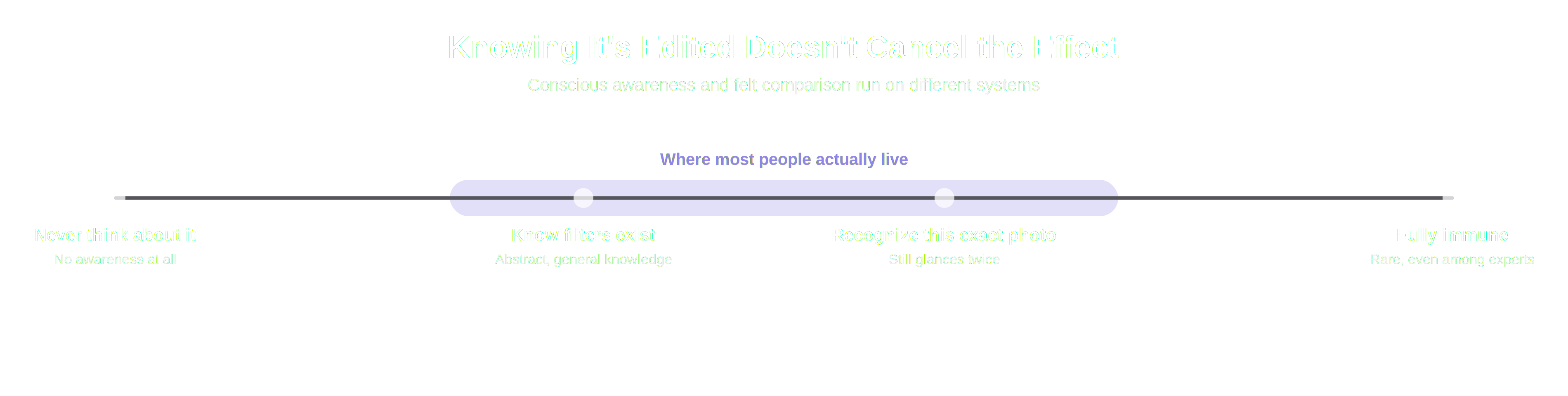
A reasonable objection to all of this is that everyone already knows, at some intellectual level, that filters and editing are common. If the knowledge is already there, why would seeing more edited photos still move the needle on how someone feels about their own face or body?
The honest answer is that conscious knowledge and felt comparison run on different systems, and one doesn't reliably override the other. A person can know, as a fact, that an influencer's jawline in a given photo was subtly reshaped, and still feel a small, automatic pang of comparison when scrolling past it, because the part of the brain doing rapid visual comparison against a reference face doesn't pause to fact-check the reference first. This is closely related to why optical illusions keep working even after you've been told exactly how they're constructed – knowing the mechanism intellectually doesn't switch off the perceptual response. Repeated exposure to an edited baseline shifts what feels "normal" at a level below deliberate, conscious belief, which is exactly why the effect shows up in survey data even among people who would say, if asked directly, that they know filters aren't real.
What Doesn't Fix This
It's tempting to reach for the simplest available fix – just stop using filters, or just spend less time on the apps – and there's some real value in both, especially for someone who notices the comparison affecting their mood specifically. But neither is a complete answer to what these statistics are actually describing, because the underlying dynamic isn't really about any individual person's editing choices. It's about a shared visual environment that has drifted, collectively, toward an edited baseline that most participants didn't choose and can't unilaterally undo just by opting out themselves.
A single person deciding not to filter their own photos doesn't change what they see when they open the app the next morning. The comparison set is still overwhelmingly edited, whether or not their own contribution to it is. This doesn't mean individual choices don't matter – they do, especially for the person making them – but it does mean the fix that actually addresses the scale of the problem has to be about the norm, not just about any one person's compliance with it.
Where Muza Fits Into This Honestly
We build editing tools, which puts us inside the exact dynamic these statistics describe rather than outside it, and we think pretending otherwise would be dishonest. What we can control is not whether editing exists – it clearly does, at a 90% adoption rate, with or without any single app's involvement – but what kind of editing our own tool nudges people toward by default, and that's the reason Muza's retouching is deliberately built around a "recognizably you, on your best day" target rather than a maximally transformative one. A tool that quietly encourages people toward heavier, less recognizable edits adds to exactly the drift these numbers describe. A tool that holds a firmer line, even when a more dramatic result might look flashier in a before-and-after screenshot, is at least not making the underlying problem measurably worse.
We don't think a single app's editing philosophy fixes a phenomenon this widespread – the numbers above weren't produced by any one tool, and they won't be undone by any one tool either. But we do think it matters which direction each individual product nudges the norm, multiplied across everyone using it, and we'd rather be a small downward pressure on that drift than one more contributor to it.
A More Honest Baseline
None of this is an argument against editing photos, and it isn't a claim that anyone doing so is making a mistake. People have always wanted their photos to look considered, and there's nothing wrong with that impulse on its own. The argument is narrower and, we think, harder to dismiss: a feed where nearly everyone edits and almost nobody says so produces a shared reference point that doesn't match reality for anyone looking at it, including the people contributing to it – and the data above suggests that gap has a real, measurable cost for a meaningful share of the people absorbing it every day.
Fixing that gap doesn't require abandoning editing altogether. It requires being more honest about what a normal, unedited baseline actually looks like, and building the tools people already use in a way that doesn't quietly widen the distance between that baseline and what a feed makes to feel normal.