
The Difference Between a Filter and a Voice

The Difference Between a Filter and a Voice
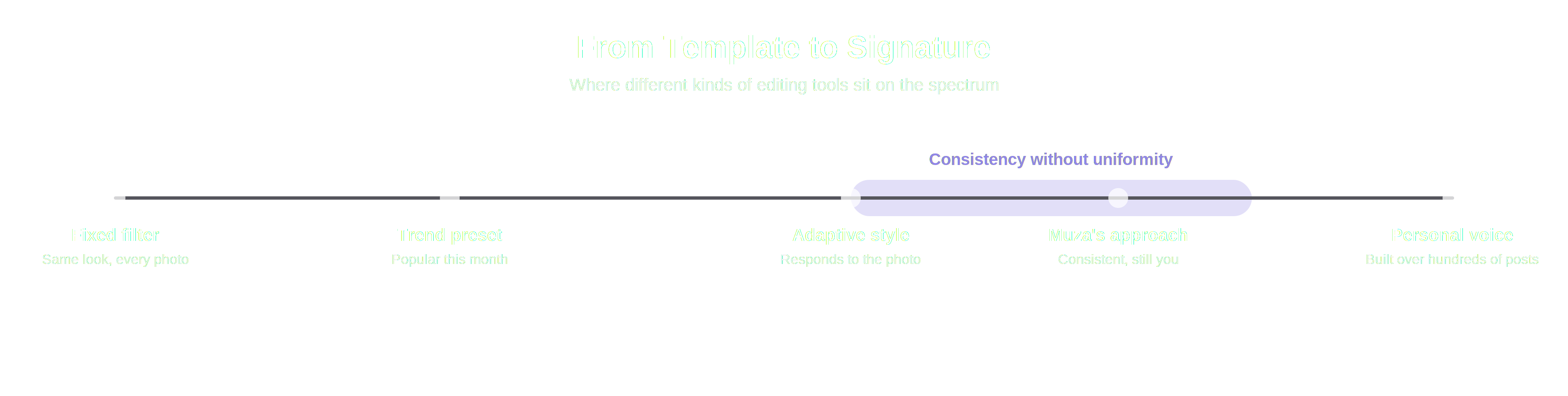
Open any filter pack and the promise is basically the same regardless of the name printed on it: tap this, and your photo will look like this other photo. That's a perfectly reasonable thing for a filter to do, and there's nothing wrong with wanting a specific mood – warmer light, moodier shadows, a particular grain. The trouble starts when that single, fixed look becomes the only thing a person's photos are known for, and every post starts looking less like them and more like the filter.
We think there's a real, useful distinction between a filter and a style, and it's not a matter of taste or branding language. It's a structural difference in what the tool is actually doing to the photo, and it shapes almost every editing decision we've made in Muza.
What a Filter Actually Does
A filter, in the strict sense, is a fixed transformation. It takes whatever comes in and pushes it toward the same output regardless of what was there to begin with – the same color curve, the same grain, the same vignette, applied uniformly. This is precisely why filters are so easy to build, so easy to name, and so easy to sell in packs of twenty: the underlying math doesn't need to know anything about the specific person in the photo. It just needs to know the target look.
The cost of that simplicity shows up the moment you look at a whole feed built entirely on one filter. Every face gets pushed toward the same undertone. Every scene gets pushed toward the same contrast. Two people who look nothing alike, wearing the same filter, start to look like they were shot on the same overcast afternoon by the same photographer with the same preset – because, functionally, they were. The filter did exactly what it was built to do. It just wasn't built to preserve anything specific about either of them.
What Gets Lost in the Uniformity
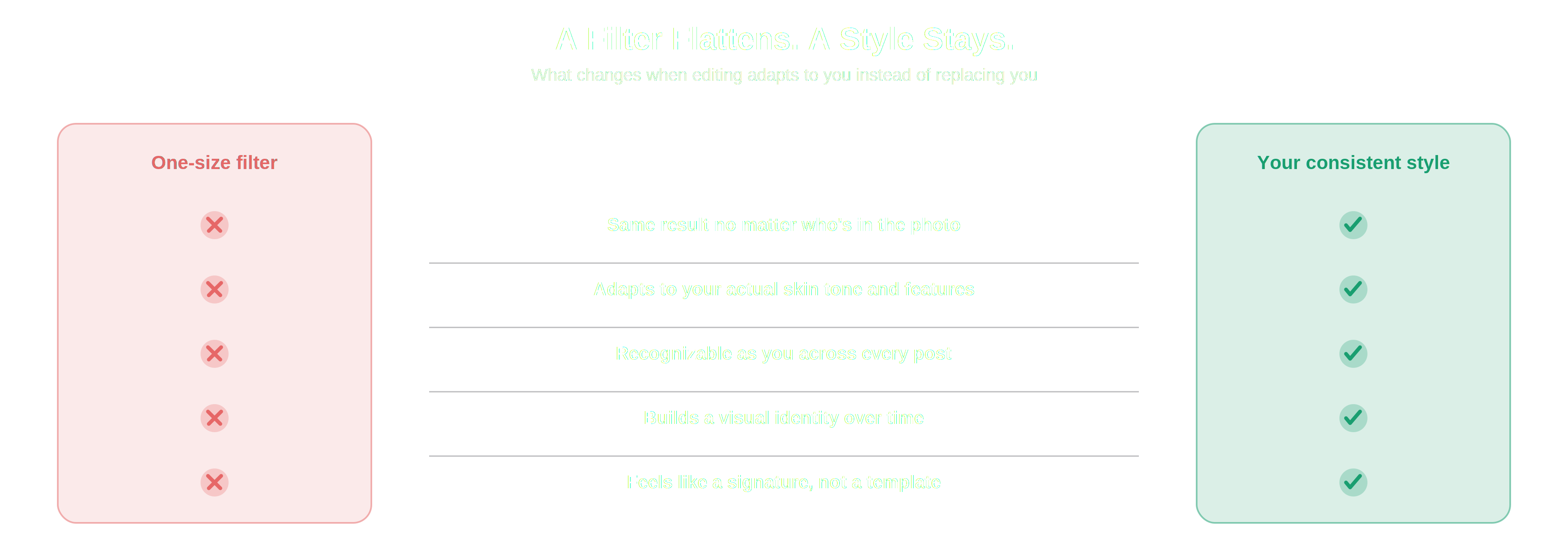
This flattening effect is easy to miss one photo at a time and impossible to miss across a whole grid. A single filtered photo still reads as a photo of a specific person; the filter is subtle enough not to erase that on its own. But scroll through a hundred photos from a hundred different accounts, all using the same trending preset, and the individual faces start to blur together into a kind of aesthetic wallpaper – technically different people, functionally the same photo, repeated.
That's the opposite of what most people actually want from editing. Nobody opens an editing app hoping to look more like everyone else using the same app. The appeal of a good edit is almost always the opposite promise: make this look more like the best version of me, not more like a template that happens to be popular this month. A tool that can't tell the difference between those two goals will, by default, drift toward the easier one – uniform output – because uniform output is what a fixed filter is built to produce.
Adapting Instead of Overwriting
The alternative to a fixed transformation is one that starts from the actual photo and adjusts relative to what's already there – skin tone, lighting conditions, facial structure, existing color balance – rather than pushing everything toward one destination regardless of the starting point. This is a harder problem to solve well, because it means the tool has to actually look at the specific photo in front of it rather than applying the same recipe every time. But it's the only approach that can produce a result that still looks like the person in the photo, adjusted for their best light, rather than a version of them wearing someone else's preset.
This is the difference we mean when we talk about a style versus a filter. A style, in this sense, isn't a single fixed look at all – it's a consistent set of adjustments relative to the input: slightly warmer skin tones, a particular way of handling shadows, a consistent approach to color grading that responds to what's actually in the photo rather than overwriting it. Two different people using the same style setting in Muza should end up with two photos that both look polished and coherent with each other in mood, while still looking distinctly like themselves – not like two versions of the same templated face.
Why Consistency and Uniformity Aren't the Same Thing
It's worth being precise about a distinction that's easy to blur: consistency across your own photos is valuable, and it's part of what makes an account or a personal archive feel coherent over time. Uniformity across everyone's photos is a different thing entirely, and it's the part we think is worth resisting. A person's grid looking recognizably like their grid – a consistent color mood, a consistent editing sensibility, a visual identity that holds together post to post – is a genuinely good outcome, and it's one editing tools can help with. That's different from every grid, across every account using the same trending preset, converging on the same look.
The tools that produce the first outcome and the tools that produce the second can look deceptively similar in a thirty-second demo. Both apply color and light adjustments; both make a photo "look better" by some reasonable definition. The difference only shows up over time, across many photos, when one approach keeps looking like an evolving version of the same person and the other starts to look like a rotating cast of people who all bought the same filter pack.
Designing Around the Person, Not the Trend
This distinction shaped a genuinely uncomfortable tradeoff during development: trend-driven, fixed-look filters are usually easier to build, easier to market with a single striking before-and-after, and easier to make go viral, because a dramatic uniform transformation photographs well in a demo regardless of who's in the original photo. An adaptive style is harder to demo convincingly in isolation, because its whole value proposition is that it behaves differently depending on the input – which is much less flashy than a single dramatic transformation applied to everyone.
We chose the harder, less flashy path anyway, because we think the actual long-term value of an editing tool isn't in the first impressive result – it's in whether someone still likes how their photos look, and still looks like themselves, six months and hundreds of photos later. A filter that produces one striking result and slowly flattens everyone who uses it into the same aesthetic doesn't hold up under that kind of scrutiny. A style that adapts to the person in front of it does.

A Voice Is Built, Not Applied
The word "voice" gets used a lot in creative fields to describe something that can't be reduced to a single formula – a writer's voice isn't one sentence structure repeated forever, it's a consistent sensibility that expresses itself differently depending on the subject. We think the same idea applies to how someone's photos should look over time. A visual voice isn't one filter, applied identically to everything. It's a consistent sensibility – in color, in light, in mood – that adapts to whatever photo it's actually working with, and still manages to look coherent across dozens of very different shots.
Building tools that support that kind of consistency, rather than tools that just apply the same fixed look to everyone, is slower, less immediately dramatic work. We think it's the right work anyway, because the alternative – a feed full of technically different people who all look like they used the same filter – isn't really giving anyone a voice at all. It's giving everyone the same one, on loan, one trending preset at a time.