
Building the Team Inside Muza

Designing an AI Crew, Not Just an Assistant
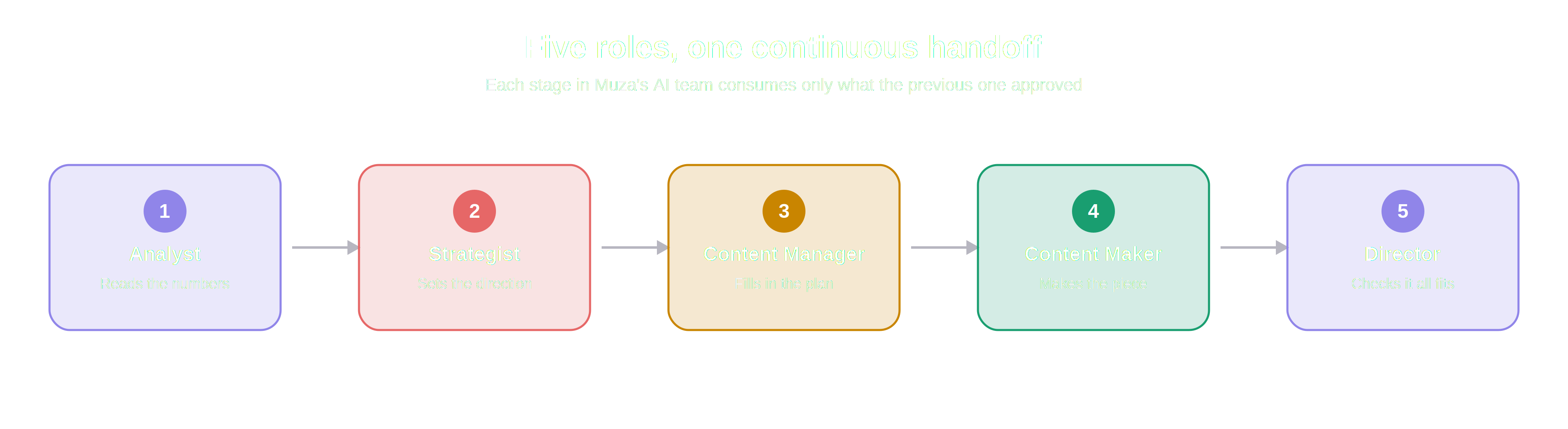
The easiest version of this feature to build would have been a single chatbot. Ask it anything about your Instagram, and it answers – analyze my page, suggest a post, write a caption, whatever you need, all from the same box. Early on, that's roughly what we prototyped. It worked, in the sense that it responded to things. It did not work in the sense that mattered: the answers were competent but interchangeable, the same voice giving strategic advice one minute and writing jokes the next, with no real accountability for whether any of it fit together.
That prototype is why Muza's SMM assistant isn't one AI. It's five, each with a name, a role, and – more importantly – a boundary it isn't allowed to cross.
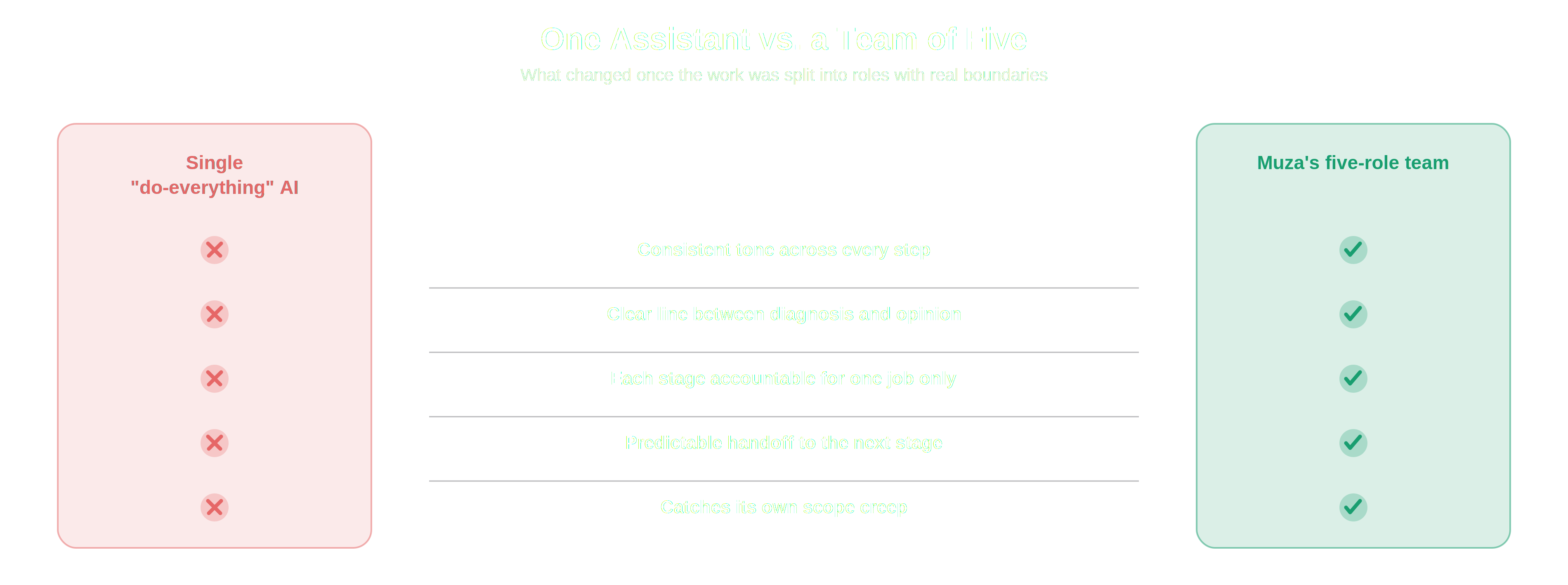
The Problem With a Single "Do Everything" AI
When you ask one general-purpose model to diagnose a profile, build a strategy, invent content ideas, write the content, and check its own quality, you're really asking it to switch hats dozens of times inside a single conversation, often without a clean line between where one job ends and the next begins. In practice, this produces a specific failure mode: strategy that quietly reads like content ideas, diagnosis that quietly reads like recommendations, drafts that quietly redefine the plan they were supposed to execute.
None of these failures are dramatic. They're subtle enough to slip past a first read, and that's exactly what makes them dangerous in a tool meant to be trusted with a real content plan. A diagnosis that has already snuck in a few opinions about what to do next isn't a diagnosis anymore – it's a decision wearing a diagnosis's clothes, and it skips the step where an actual strategy gets built on solid ground.
There's also a simpler, more human reason a single assistant tends to disappoint: it never remembers, in any structural sense, which hat it's currently wearing. Ask it to be rigorous and skeptical while analyzing a profile, then immediately ask it to be warm and persuasive while writing a caption, and you're asking one continuous process to hold two contradictory postures at once. People solve this by literally becoming different people for different parts of their job – more clinical during a strategy meeting, more expressive while writing. A single model, without an enforced structure, tends to average the two instead of switching cleanly between them.

Five Roles, Five Boundaries
We settled on five distinct roles, each mapped to one stage of how professional content teams already work, whether they know it or not.
The Analyst looks at what's actually there – a profile's numbers, its competitors, its existing content – and describes it honestly. No sugarcoating, and just as importantly, no prescribing. The Analyst's entire job ends the moment an opinion about what to do next would start.
The Strategist takes that diagnosis and turns it into a direction: positioning, content pillars, how often to show up. This is the first point where opinion is allowed – but only opinion about direction, not about specific posts.
The Content Manager takes that direction and fills it in: what each slot in the plan is actually about, the angle, the hook, the format. Still not the finished piece – just a clear, specific brief for what the finished piece needs to accomplish.
The Content Maker takes that brief and produces the actual thing – the script, the photo concept, the caption, whatever the format calls for. This is the only role that touches the finished product directly.
The Director doesn't create anything. It reviews what the other four have produced, keeps the whole sequence moving, and makes sure nothing ships that doesn't sound like the same account that posted last week.
Each role is only as useful as the boundary around it. A Strategist that starts writing captions has stopped being a strategist. A Content Maker that starts redefining the marketing goal has stopped executing and started freelancing. The value of the system isn't really the five roles themselves – it's the discipline of keeping each one inside its lane, the same discipline that keeps a real production team from stepping on itself.
Where the Roles Almost Overlapped
This sounds cleaner in hindsight than it was to design. Two collisions came up repeatedly during development, and both are worth naming because they're the kind of thing that looks fine on a whiteboard and only breaks in practice.
The first was between the Analyst and the Strategist. Early versions of the Analyst's brief asked it to describe a profile's "content rubrics" – the categories of things it already posts about. But rubrics going forward were supposed to be the Strategist's call to make. Using the same word for "what a profile already does" and "what a profile should do next" made it far too easy for the Analyst to start drifting into recommendations without anyone noticing, including us. The fix was almost embarrassingly simple: rename the Analyst's version to "content pillars" and add an explicit line at the end of its brief – everything you produce is a diagnosis, not a recommendation. Small change, but it closed a gap that would otherwise have quietly reappeared every time the model was asked to be a little more helpful.
The second collision was between the Content Manager and the Content Maker, and it came from a different direction entirely – not language, but the nature of the medium itself. The original plan had a "Scriptwriter" role, focused only on video scripts. But Muza's photo and video generation run through one underlying production pipeline, not two separate ones, which meant a role defined only around scripts would have no natural home for a carousel concept or a plain Stories caption. We rebuilt that role around the actual shape of the output – a script when the format is video, a photo concept when it's a carousel, straightforward copy when it's text – rather than around one specific medium. The lesson generalized beyond this one role: define an AI's job by the job that needs doing, not by the first example that comes to mind.

Testing the Boundaries With Real Prompts
Design decisions like these don't hold up on paper alone – they hold up, or fall apart, the first time a real request comes in that wasn't anticipated. Two patterns showed up repeatedly during testing that shaped the final rules.
The first was scope creep disguised as helpfulness. A model asked to analyze a profile's Instagram bio and pinned posts would sometimes start rewriting them, because rewriting felt like the more useful answer. This is a reasonable instinct in a general assistant and exactly the wrong one inside a role built to diagnose, not decide. We spent real time researching how professional social media audits actually separate "reviewing existing packaging" from "creating new packaging" before settling on the current line: the Analyst can flag that a bio no longer matches the current positioning, but the actual rewrite belongs downstream, once a Strategist has set a direction worth writing toward.
The second pattern was near-duplicate output fields that meant almost the same thing but not quite. At one point, the same brief asked for both a "content mix" and a "content pillars" field, and a careful read showed they were describing the same underlying concept twice, just with different words. That kind of duplication doesn't just waste space – it invites two roles, or two parts of the same role, to quietly drift out of sync with each other over time. Merging the two into a single, consistently named field was a small fix with an outsized effect on how coherent the final plan reads.
The Universal Rules Underneath the Five Roles
Beyond the five role-specific briefs, there's a short list of rules that apply to all of them equally, and it grew directly out of watching where the roles kept tripping over the same handful of problems.
The first is a fixed-input rule: once a document is approved – a marketing task, a set of content pillars, a topic – no downstream role is allowed to quietly rewrite it. A Content Maker that decides, mid-draft, that the assigned topic could be better, is not being creative; it's undermining a decision someone upstream already made and the user already signed off on.
The second is a no-guessing rule: when a role is missing a piece of information it actually needs – team structure, a deadline, whether a reference post exists – the instruction is to say so plainly and ask, rather than quietly filling the gap with something plausible-sounding. A confident-sounding guess is worse than an honest "I don't know," because it's much harder to catch later.
The third is a stay-in-lane rule, which is really just the five-role boundary system stated as a general principle rather than five separate ones: never perform another role's job, even if you technically could.
Writing these once, as shared rules, instead of repeating slightly different versions of them inside all five briefs, turned out to matter more than we expected. Repetition invites drift – five roles independently phrasing "don't guess" five slightly different ways is five places for the instruction to slowly go stale as the product evolves. One shared rule, referenced everywhere, ages much better.

What This Actually Looks Like For You
None of this design work is meant to be visible day to day. What you see is simpler: your profile gets read honestly, a direction gets proposed, a month's worth of ideas gets filled in, the ideas turn into finished posts, and someone is quietly checking that all of it still sounds like you before it ships. The five-role structure is the reason that sequence holds together instead of drifting – the reason a plan built in week one still makes sense by week four, instead of slowly turning into five different tools that happen to share an interface.
Building a single clever assistant would have been faster. Building a team that knows exactly where its own job ends took longer, and it's the reason the result holds up under actual, repeated use rather than just looking good in a demo.
None of this is treated as finished. The same discipline that shaped these five roles – watching for where a boundary gets crossed, naming the exact collision, fixing it with the smallest possible change – is the same process we expect to keep running as real usage surfaces new edge cases we didn't anticipate at a whiteboard. A structure like this earns trust slowly, one caught overlap at a time, and that's the pace we're planning for.